

If you keep doing “the right things” but still feel stuck, overwhelmed, or reactive, it might not be your effort. It might be the state you’re operating from.
In the Live Free framework, there are two core modes: Confined State and Free State. When you can recognize which one you’re in, you stop treating your stress response like a personality trait, and you get a practical way to shift.
This post will help you (1) understand the difference, (2) spot the signs, and (3) use a simple 2-minute protocol to move toward Free State when you need it.
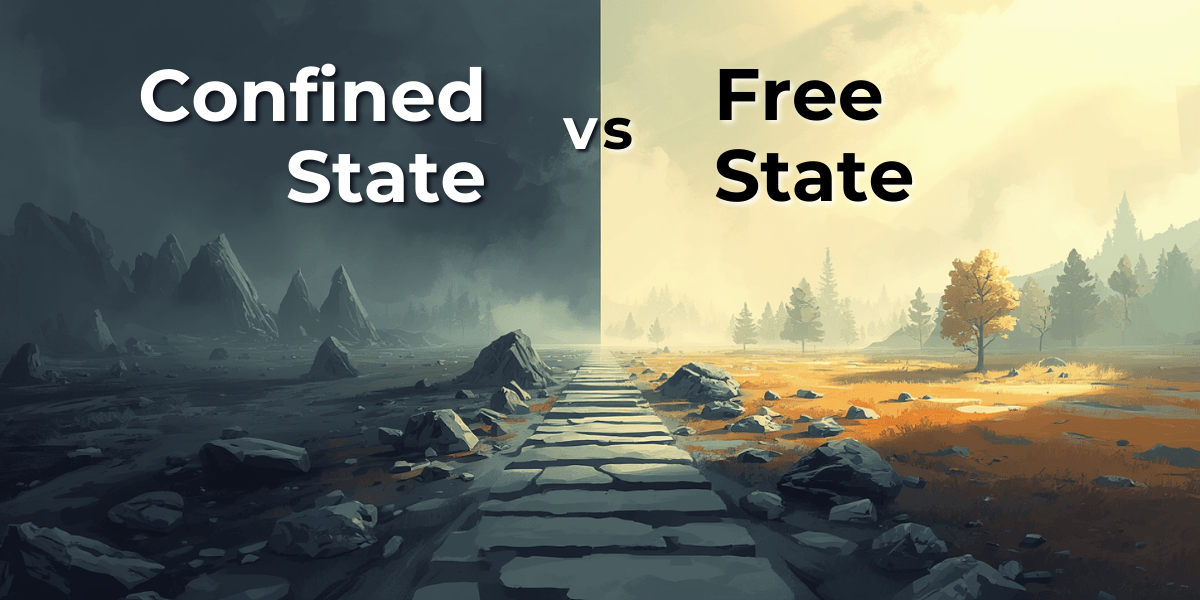
Confined State vs Free State
Confined State is what many people mean by “survival mode.” It’s a threat-first mode where your attention narrows, urgency rises, and your options feel limited. You might notice overthinking, irritability, procrastination, perfectionism, shutdown, or that “I can’t do this” feeling, even when you are capable.
Free State is not “never stressed.” It’s a mode where you have more access to clarity, patience, problem-solving, and steady action. Pressure can still be present, but you are less trapped inside it. You can see options again.
A lot of frustration comes from trying to solve Confined State problems with more force, more control, or more information, while the internal state stays the same.
Why good strategies sometimes stop working
Many people bounce between what they want to change (overwhelm, anxiety, burnout, stuck patterns) and what they try (routines, journaling, therapy, productivity systems, mindset work). Those can help, but they often fade when your internal state keeps snapping back to threat-first processing.
A useful way to understand this is through two simple ideas we teach elsewhere: the Three Columns (what you want to change, what you try, what you actually want) and the Three Powers (Focus, Meaning, Action). You do not need the full model to use this post, just this: your state shapes what you notice, what it means to you, and what you do next.
How to tell which state you’re in
You do not need perfect self-awareness. Surprisingly, even just a little awareness makes a huge difference.
Common Confined State signals
- Your mind locks onto threat, problems, or what might go wrong
- You feel urgency, pressure, or a tight “must fix now” energy
- Options feel limited, and you keep looping the same thoughts
- You feel foggy, reactive, stuck, or unmotivated
- You reach for control, avoidance, numbing, or overwork to get relief
Common Free State signals
- You can see challenge and opportunity, not just threat
- Your thinking feels clearer, wider, and more solution-oriented
- You feel calmer in your body, even if life is busy
- You can take a clean next step without panic
- You feel more like yourself, not like you’re bracing against everything
Common triggers
Confined State can be triggered by uncertainty, conflict, deadlines, “not enough time,” fear of disappointing someone, or anything your system interprets as a threat to safety, connection, value, progress, or control. This is why a small moment can flip your whole day.
The 2-minute state shift protocol
This is not about forcing positivity. It’s about shifting your state enough to regain options and agency.
2-Minute State Shift (Confined to Free)
- Name the state (10 seconds)
Say: “I’m in Confined State right now.” Naming it creates a little space. - Reset the body signal (30 to 45 seconds)
Do 1 to 2 rounds of the physiological sigh: two inhales through the nose (back to back), then one long exhale through the mouth. - Widen the lens (15 to 20 seconds)
Scan the room slowly. Soften your eyes. Look a little farther than the problem. You are telling your system you are not trapped. - Choose one clean next step (45 to 60 seconds)
Ask: “What is the smallest next step I can take from a steadier place?” Then do that step.
A Tuesday-life example
It’s Tuesday afternoon, you’re behind, and an email pops up: “Can you talk later?” Your brain fills in the worst-case scenario and your body tightens. That’s Confined State.
So instead of spiraling, you name it. You do one physiological sigh. You recenter yourself in the present moment by scanning the room. Then you choose a clean next step: reply, “Yes, what time works?” and finish one 10-minute task you can complete right now. The problem didn’t disappear, but the spiral weakened, and you got your agency back.
That’s the goal.
Get the PDF guide: The Hidden Reason Life Feels Overwhelming
Mistakes and quick fixes
Mistake: Waiting until you’re fully spiraling. It’s easier to shift early. Fix: treat the first signs as your cue to do one round of the protocol.
Mistake: Using pressure as your only fuel. Many high achievers learn the belief, “I need urgency to perform.” Fix: practice creating momentum from clarity, not stress.
Mistake: Tool-hopping. New routine, new system, new insight, then the same pattern returns. Fix: keep the tools you like, but shift state first so those tools actually stick.
Carry it forward this week
Pick one trigger that happens regularly (inbox, bedtime with kids, Sunday night, hard conversations). Decide your “state shift minimum” ahead of time: one physiological sigh, widen the lens, then one clean next step. Repeat that one rep all week. Consistency beats intensity.
Quick glossary
Confined State: threat-first, narrowed options, urgency and reactivity rise.
Free State: clearer, wider options, steadier action and better access to your capabilities.
The takeaway
You do not need to fix your whole life today. You just need a repeatable way to shift out of Confined State when it shows up, so you can respond from a steadier place.
If you want the clean companion to this post, the guide walks you through the same core idea in a format you can revisit anytime.
Get the PDF guide: The Hidden Reason Life Feels Overwhelming
Protocol box:
2-Minute State Shift Protocol (Confined to Free)
Time: 2 minutes
Use when: urgency, spiraling thoughts, shutdown, reactivity, “I can’t do this” energy
- Name it: “I’m in Confined State right now.” (10s)
- Physiological sigh: two inhales through the nose, one long exhale through the mouth. Do 1 to 2 rounds. (30–45s)
- Widen the lens: scan the room slowly, soften your eyes. (15–20s)
- Choose one easy next step: “What is the smallest helpful action I can take right now to move forward in a calm mental state?” Do it. (45–60s)
Success criteria: your body softens slightly, you can see more options, you can move forward without panic.
Troubleshooting: if you still feel flooded, repeat step 2 once, then take a 3–5 minute break before deciding anything.
